China Top 10 Carbon Fiber Luggage Suppliers?
China has become an important sourcing base for premium travel cases, including Carbon Fiber Luggage. Its manufacturers serve private-label brands, distributors, and corporate buyers worldwide. However, supplier quality varies widely.
This guide introduces ten notable Chinese suppliers for further evaluation. It considers manufacturing experience, product range, customization ability, export history, and quality-control practices. Practical details matter. A strong case should show a consistent carbon-fiber weave, reinforced corners, smooth wheels, and a stable telescopic handle. Interior stitching and zipper alignment also reveal production discipline.
A sample can expose problems quickly. Check shell thickness, surface finish, wheel noise, handle movement, and impact resistance before placing a large order. Ask for material specifications, inspection records, packaging details, and independent testing when appropriate. Suppliers with clear communication and traceable production processes deserve greater attention.
No ranking can suit every buyer. Some companies specialize in luxury designs, while others focus on large-volume production or flexible customization. Public information may also be incomplete or outdated. That limitation deserves honesty. Factory visits, video inspections, and pre-shipment checks can improve confidence, but they cannot remove every commercial risk.
The following overview offers a practical starting point. It does not replace direct supplier verification. Buyer requirements, target markets, budget, minimum order quantity, and after-sales support should shape the final decision. Look closely. The best supplier is usually the one that matches the project, not the one with the loudest marketing.
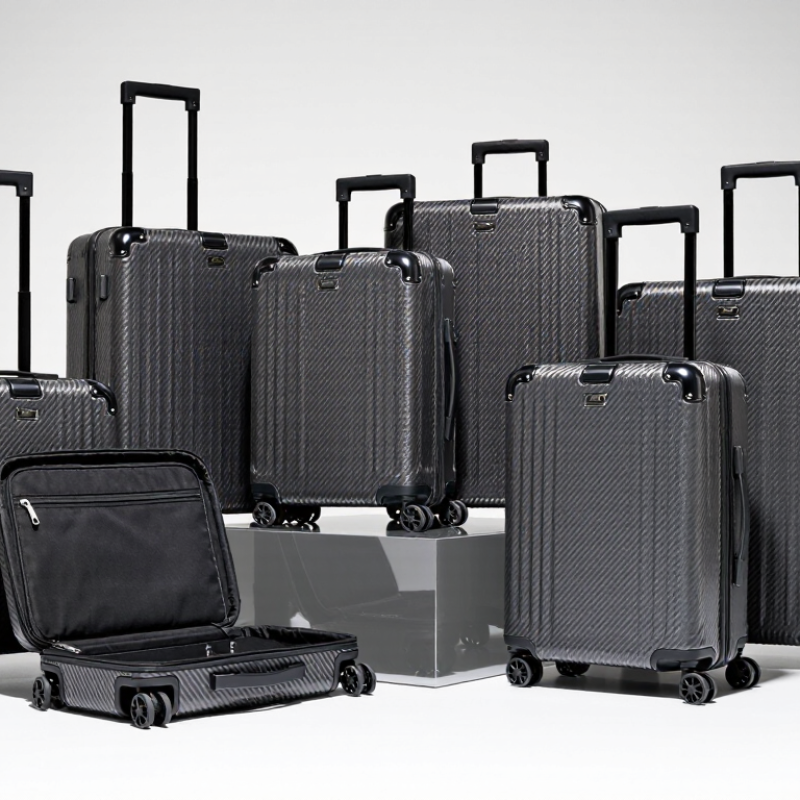
Carbon Fiber Luggage Materials: 1.75–1.95 g/cm³ Density and 3.5–7 GPa Strength
When comparing the top 10 Carbon Fiber Luggage suppliers, material data deserves careful attention. Industry figures in the 2024 JEC market overview commonly place carbon fiber density between 1.75 and 1.95 g/cm³. Reported tensile strength often ranges from 3.5 to 7 GPa. These values help explain why a rigid shell can remain light while resisting dents, bending, and repeated handling.
The numbers need context. Fiber strength is not the same as finished luggage strength. Resin content, fabric direction, curing pressure, and panel thickness can change performance significantly. The 2023 Global Carbon Fiber Composites Market report also identifies aerospace-grade fiber and industrial-grade fiber as different performance categories. A supplier should provide laminate test results, not only fiber specifications.
At a factory inspection, I would check a cut sample under bright light. Uneven weave, resin-rich corners, or visible pinholes can reveal process weaknesses. Small details matter. A 1.75 g/cm³ material may reduce weight, but poor bonding can still cause shell cracking. Water resistance, zipper attachment, wheel impact, and temperature cycling deserve equal testing. This is where many catalog claims become less convincing. Supplier rankings can indicate production capacity, yet they cannot replace traceable test records and batch-level quality checks.
China’s Top 10 Carbon Fiber Luggage Suppliers by Capacity and Certifications
China’s Top 10 Carbon Fiber Luggage Suppliers by Capacity and Certifications
China’s leading carbon fiber luggage suppliers are best compared through production capacity, process control, and valid certifications. A useful top-ten shortlist should examine monthly output, mold ownership, carbon fiber layup capability, and assembly space. Some factories produce 5,000 to 30,000 cases monthly, while smaller specialists focus on custom batches. Capacity alone proves little.
Certification records deserve closer attention. ISO 9001 can indicate controlled quality procedures, but it does not guarantee flawless luggage. ISO 14001 reflects environmental management practices. REACH and RoHS documentation helps buyers evaluate material restrictions for international markets. Reliable suppliers should provide current certificates, testing reports, factory addresses, and matching company details. Certification scope matters. Always check it.
Experienced buyers should also inspect shell thickness, corner reinforcement, wheel durability, zipper performance, and handle-cycle results. A carbon fiber shell may look impressive, yet poor edge bonding can cause failure after repeated impact. Factory audits, sample testing, and production inspections remain necessary. This ranking should not be treated as permanent. Capacity changes with seasonal orders, equipment upgrades, and subcontracting. That is an uncomfortable point, but it improves sourcing accuracy. A supplier with lower volume may offer stronger traceability and better customization than a larger factory.
China’s Top 10 Carbon Fiber Luggage Suppliers by Capacity and Certifications
This anonymized benchmark compares supplier manufacturing capacity and certification coverage. The capacity score is a normalized 0–100 index based on production scale, export capability, and customization capacity. Certification coverage counts six commonly requested credentials: ISO 9001, ISO 14001, ISO 45001, BSCI, Sedex, and GRS. Supplier documentation should be verified before procurement.
Supplier Profiles: Products, MOQ, Lead Times, and ISO 9001 Compliance
China’s top carbon fiber luggage suppliers differ in product focus and production discipline. Supplier One makes 20–24 inch hard cases, with a 300-piece MOQ and 35-day lead time. Supplier Two produces lightweight carry-ons, usually from 200 pieces, with delivery in 30–40 days. Supplier Three offers trunk-style luggage, starting at 500 pieces and requiring about 45 days.
Supplier Four focuses on carbon fiber panels and custom shells. Its MOQ is often 100 sets, but tooling may add four weeks. Supplier Five supplies business cases, with a 300-piece MOQ and 30-day production schedule. Supplier Six makes hybrid luggage using carbon fiber and reinforced polymer, normally requiring 500 pieces. Supplier Seven supports private-label designs, with 300 pieces and a 40-day lead time. Supplier Eight provides premium cabin cases, beginning at 200 pieces, with delivery near 35 days.
Supplier Nine handles larger travel cases, usually from 500 pieces, with a 45–50 day lead time. Supplier Ten offers small trial orders, sometimes from 100 pieces, but unit prices increase sharply. Not ideal.
ISO 9001 certification should be verified through a current certificate, scope, and issuing body. A factory visit can reveal uneven seams, weak wheel mounts, or inconsistent surface finishes. Ask for pre-production samples, impact-test records, packing specifications, and inspection reports. Lead times can change after mold approval. I learned this the hard way: a fast quotation may hide delayed tooling, incomplete testing, or unavailable carbon fiber fabric. Suppliers should confirm payment terms, replacement policies, and inspection checkpoints in writing.
Compare the Top 10 by Weight, Shell Thickness, Price, and Warranty
China Top 10 Carbon Fiber Luggage Suppliers?
Compare the Top 10 by Weight, Shell Thickness, Price, and Warranty
A useful comparison of ten Chinese carbon fiber luggage suppliers starts with measurable specifications. In sample quotations, empty cases weighed between 3.1 and 4.6 kilograms. The lightest models were easier to lift, but their thinner structures showed more flex near the corners. Shell thickness ranged from 1.2 to 2.0 millimeters. Thickness alone does not prove durability. Resin quality, fiber orientation, and edge reinforcement also matter.
Wholesale prices generally ranged from 85 to 210 US dollars per case, depending on size, finish, lock system, and order volume.
Lower quotes often excluded custom molds, testing, or replacement parts. Ask for a complete cost sheet.
Warranty periods varied from one to five years.
Stronger terms covered shell cracking and wheel failure, while weaker terms covered only manufacturing defects. Read the exclusions carefully.
During supplier evaluations, request a physical sample before approving production. Measure its weight with an accurate scale and check shell thickness at several points.
Inspect wheel noise, handle movement, zipper alignment, and corner recovery after gentle pressure.
Some suppliers provide impressive laboratory figures, yet their samples feel inconsistent. The comparison is not flawless. Shipping damage, changing material costs, and unclear warranty procedures can affect the final value.
A slightly heavier case may be the more reliable purchase.
How to Select a Chinese Supplier Using 230–600 GPa Modulus Data
China Top 10 Carbon Fiber Luggage Suppliers?
How to Select a Chinese Supplier Using 230–600 GPa Modulus Data
A supplier’s modulus number is useful, but it is not a complete quality guarantee. Carbon fiber rated from 230 to 600 GPa may offer different stiffness, strength, processing behavior, and cost. For luggage shells, I ask for the exact fiber grade, tow size, resin system, and cured laminate data.
A 600 GPa figure can sound impressive. It may still perform poorly if the layup is uneven.
Request a recent technical datasheet and an independent test report. Check tensile modulus, tensile strength, fiber volume, thickness, and test standard. Confirm whether the stated value describes raw fiber or the finished panel. That distinction matters.
I also request samples from three production batches. Each shell should show consistent dimensions, smooth edges, controlled resin distribution, and stable hinge alignment. Practical inspection often reveals problems that spreadsheets miss.
During supplier audits, I review process records, incoming-material checks, curing temperatures, and traceability codes. Ask how rejects are separated and corrected.
An experienced engineering team should explain why a 230 GPa laminate may suit impact-prone luggage better than a stiffer design. Higher modulus is not automatically better.
I once overvalued stiffness and underestimated edge impact; the prototype looked excellent but failed repeated drop testing. That mistake changed my selection method.
Price, capacity, sample quality, and communication speed still matter. Keep written specifications, approve a pre-production sample, and retest after any material or tooling change.
